Aliexpress WW
Aliexpress WW

What the Best Adjusting Column Width And Row Height Pros Do (and You Should Too)

Introduction

By the end of this lesson, you should be able to:

  • Adjust column width and row height

Adjusting column widths

By default, Excel's columns are 8.43 characters wide, but each individual column can be enlarged to 240 characters wide.
If the data you are entering in your worksheet is wider or narrower than the default column width, you can adjust the width so it is wide enough to contain the data.

Important pointYou can adjust column width manually or use AutoFit.

Adjusting column width two ways

Manually:

  • Place your mouse pointer to the right side of the column header.
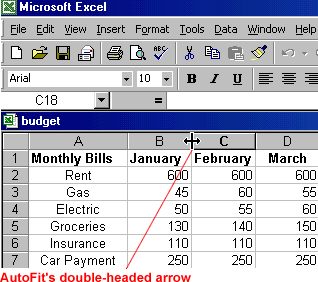
  • The mouse pointer changes to the adjustment tool (double-headed arrow).
  • Drag the edge of the column header to the desired width and release the button.

AutoFit:

  • Place your mouse pointer to the right side of the column header.
  • The mouse pointer changes to the adjustment tool (double-headed arrow).
  • Double-click the column header border.
  • Excel autofits the column, making the entire column slightly larger than the largest entry.
Important pointTo access AutoFit from the menu bar, choose FormatLesson ActionColumnLesson ActionAutoFit Selection.

AutoFit's double-headed arrow

Adjusting row height

Adjusting row height is similar to adjusting column width.

To adjust row height:

  • Place your mouse pointer on the lower edge of the row heading you want to adjust.
  • The mouse pointer changes to the adjustment tool (double-headed arrow).
  • Double-click to adjust the row height to autofit the font size.
  • Drag to manually increase or decrease size.
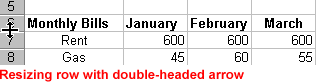
Resizing row with double-headed arrow

Did you know?

When entering data into a worksheet, never leave blank columns between data-filled columns. Blank columns create major problems when performing advanced Excel functions such as making charts and sorting data.

Don't use columns to create space between your columns. Instead, adjust column width so your data is easy to read and understand.

Comments

Popular posts from this blog

The Advanced Guide to Colours In Graphic Design

The power of color Color plays a vital role in  design  and  everyday life . It can draw your eye to an image. Sometimes it can trigger an emotional response. It can even communicate something important without using words at all. So how do we know which colors look good together and which ones don't? The answer is simple:  Color theory . Artists and designers have followed  color theory  for centuries, but anyone can learn more about it. It can help you feel confident in many different situations, whether it's  choosing colors for a design  or  putting together the perfect outfit . With a little insight, you'll be looking at color in a whole new way. Color basics Let's start at the beginning with a refresher on the basics. Remember learning about  primary and secondary colors  in school? Then you already have some knowledge of color theory. Secondary colors  are created by combining two  primary colors...

The Ultimate Glossary of Terms About Typography In Graphic Design

What is typography? Typography is everywhere we look. It's in the books we read, on the websites we visit, even in everyday life—on street signs, bumper stickers, and product packaging. But what exactly is typography? Simply put, typography is the style or appearance of text . It can also refer to the art of working with text—something you probably do all the time if you create documents or other projects for work, school, or yourself. Common types of fonts Typography can be an intimidating subject, but it doesn't have to be. You only need to know a little to make a big difference in the stuff you do every day. So let's get started. First, some common types of fonts  and what you need to know about them. Serif fonts Serif fonts have little strokes called  serifs attached to the main part of the letter. Because of their classic look, they're a good choice for more  traditional projects . They're also common in print publications, like magazines an...

The Ultimate Cheat Sheet On Making Basic Adjustments In Image Editting

Introduction Image editing is all about adjusting your images to make them look better. We're going to talk about some of the most  basic image adjustments , along with some common problems to watch out for when making these changes. The adjustments we'll cover in this lesson include: Cropping : If you want to remove parts of an image, you can  crop  it. You can think of cropping as using a pair of scissors to  cut out  the parts you no longer want. Resizing : If you want to make an image smaller or larger, you can  resize  it. However, keep in mind that making an image larger than its original size generally does not look good. Rotating : If you want to change the  orientation  of an image, you can  rotate  it to the left or right. Optional : If you'd like to follow along, you can download some or all of our  example images . Just click any of the images below to open a full-sized version. Then right-click the full-si...